
Mljet in one day: lakes, monastery, bike loop.
How we plan a day in Mljet National Park: the crossing, the saltwater lakes, the monastery islet and the bike loop.

In this guide
A third of Mljet is a national park, with pine forest down to the waterline. In the park are two saltwater lakes, and on an islet in the larger lake stands a 12th-century Benedictine monastery.
Mljet National Park tour (8–9h)See the tour →
The crossing
From Dubrovnik the crossing takes about 90 minutes by speedboat, past the Elaphiti Islands; slower boats take longer. We dock at Pomena, a ten-minute walk from the park entrance. Passengers on the public catamaran land at Polače, at the other end of the park, about 40 minutes’ walk from the lakes.
The two lakes
Veliko jezero and Malo jezero, the large and small lakes, are linked to each other and, through a narrow channel, to the sea. They are salt water but usually a couple of degrees warmer than the open sea.
The monastery islet
The islet of St Mary, with its monastery, is in the middle of the large lake and is reached by a park boat included in the entry ticket. Allow about 45 minutes for the cloister and a coffee at the islet café.
The bike loop
Bikes can be rented at Mali Most, the bridge between the lakes. The loop around the large lake is 9 km, flat and car-free, and takes about an hour, with swimming spots along the way.
Planning a Mljet National Park day trip
A Mljet National Park day trip from Dubrovnik works best when you decide in advance how you want to spend the five or so hours on the island. Walking, cycling and swimming in the lakes all fit, but not all at a relaxed pace. Most guests pick two: the monastery and a swim, or the bike loop and a swim.
The alternative to a private boat is the public catamaran. It runs on a fixed timetable and arrives at the far end of the park. The other option is the car ferry from the Pelješac side, which means a long drive before you even reach the island. For a single day from Dubrovnik, the boat to Pomena is the simplest option.
- Park ticket: bought at the park entrance and paid separately. It covers the park boat to the monastery islet. The price is set by the park and differs between high and low season.
- Cash or card: bring something for the ticket, bike rental, lunch and a coffee on the islet.
- Shoes: the paths around the lakes are gravel and roots, so trainers or sandals with a strap are better than flip-flops.
- Price of the tour: on request. We quote per boat, not per person, and send an itemised quote by email or WhatsApp.
Beyond the lakes
The lakes and the monastery are what most people come for. But Mljet is a long island, about 37 km from end to end, and the park covers only its western part. A few other places are worth knowing about:
- Polače, a small harbour village inside the park with the walls of a large late-Roman palace standing right by the waterfront.
- Pomena itself, where we dock: a short promenade, a few restaurants and a quiet bay for a last swim before the return.
- Odysseus Cave near Babino Polje, a sea cave linked by local legend to Homer’s Odyssey. It is outside the park and usually a separate plan.
- Saplunara, at the eastern tip of the island, one of the few sandy stretches in the area.
Every trip is private, so stops can be swapped or added. Ask when you plan the day, and the skipper will tell you what fits with the time and the weather.
Park rules worth knowing
Mljet is a national park, and the rules are what you would expect in a protected area. Keep to the marked paths and the lake road, take your rubbish back with you, and do not pick plants or disturb wildlife. Swimming in the lakes is allowed and is one of the best parts of the day. Cyclists share the lake road with walkers, so ride slowly near the bridge at Mali Most and the boat stops.
The monastery islet is a religious site as well as a monument. Bring something to cover your shoulders if you want to go inside the church.
Season, heat and who it suits
June and September are the best months: warm sea, long days and fewer visitors on the paths. July and August are the hottest and busiest, so book two to four weeks ahead. Plan your walking for the morning, when the pine shade is cooler. In May and October the lakes are calm and the park is quiet, though the open sea is cooler for swimming.
In the heat, bring a refillable bottle and a hat for the walk. There is water on board, and the shade under the pines is the coolest place on the island at midday.
It is a long day, so it suits older children best. For toddlers we usually suggest the shorter Elaphiti Islands tour. If anyone is prone to seasickness, tell us in advance. Most of the crossing runs past the Elaphiti. On days with a strong jugo or bura, we check the forecast the day before and contact you if conditions look uncertain. If it is not safe, you can reschedule or receive a full refund of your deposit.
Staying on Mljet
If you want more than a day, you can spend a night or two on the island and travel one way by boat. Our private boat transfer to Mljet takes you to the harbour you need. For the day itself, see the Mljet National Park boat tour for the route, the boats and what is included.
Nature in the national park
The western part of Mljet has been a national park since 1960 (Mljet National Park official site). Most of it is covered in Aleppo pine and holm oak forest, among the best preserved on the Adriatic islands. The lakes are really sea bays with a narrow, shallow link to the open sea. That is why they warm up early in the season and stay calm when the open water is rough.

Walking the shore, you may see a mongoose rather than a squirrel. The small Indian mongoose was brought to the island in 1910 to control snakes, and its descendants still live in the forest. Swimmers often spot fan mussels and seagrass meadows on the sandy floor of the lakes; both are protected, so look but do not touch.

Tickets, timetables and park news
The ticket price, what it includes and the park boat timetable are set by the park authority and change with the season. The Mljet National Park website is the place to check them, along with any temporary closures of paths or the monastery. We plan the day around the park boat to the islet so you do not lose time waiting at the jetty.
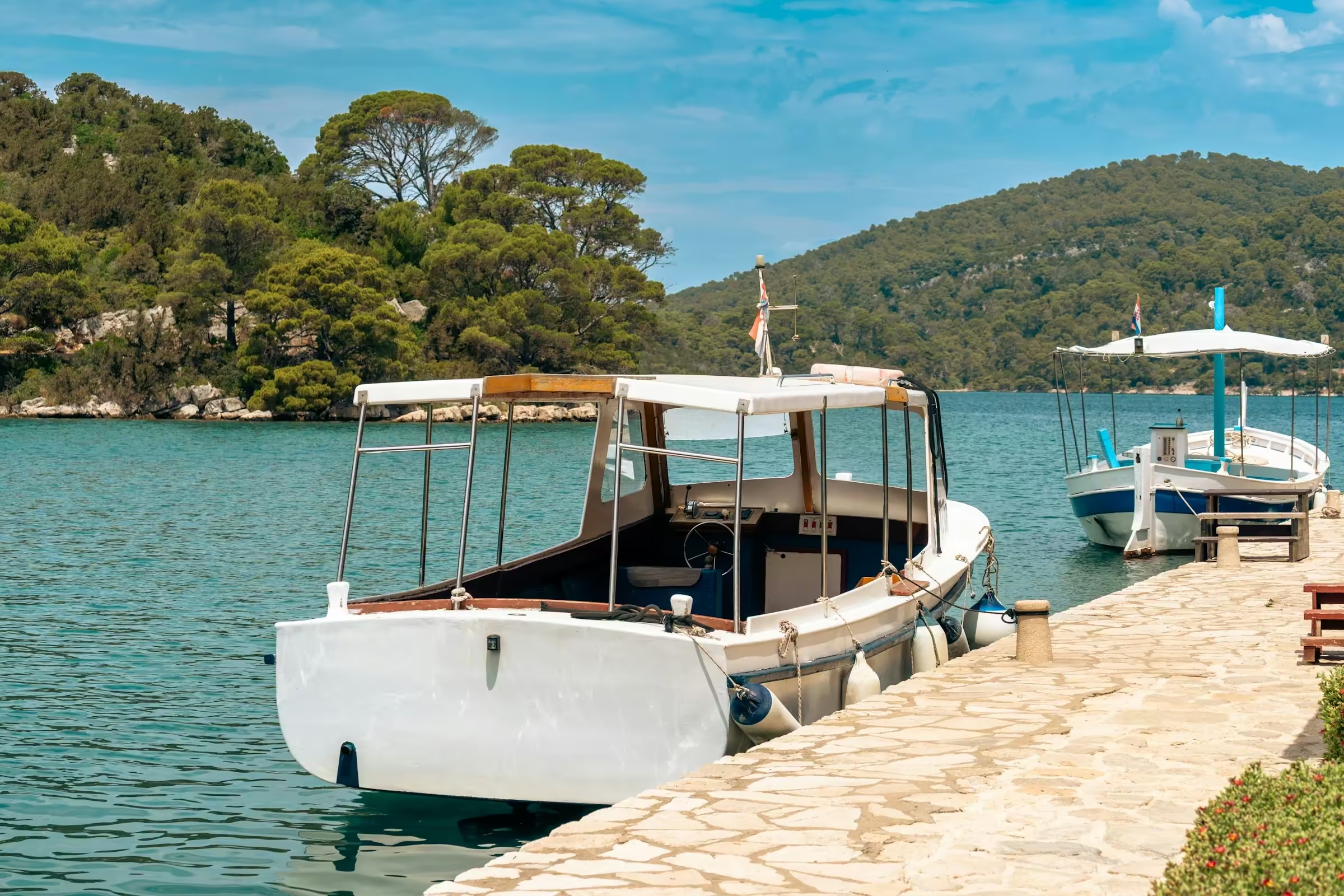
The crossing to Mljet includes one of the longer stretches of open sea we run, so on days with swell a heavier boat helps. Our guide to choosing a boat explains why.
Keep reading
- Elaphiti Islands guide: the islands you pass on the way to Mljet.
- Korčula in a day: the island across the channel, for a second day.
- What to pack for a boat day: shoes for the lake paths and cash for the bikes.
- Book it: Mljet National Park boat tour or a one-way boat transfer to Mljet.


